
What changed for 2026
- The Student Direct Stream (SDS) closed on November 8, 2024. Every applicant now applies through the regular study permit stream. A Guaranteed Investment Certificate (GIC) is no longer compulsory, though IRCC still accepts it as proof of funds.
- From January 1, 2026, master’s and doctoral students at public DLIs no longer need a provincial or territorial attestation letter (PAL/TAL).
- For applications made on or after September 1, 2026, a single student applying for a program outside Quebec must show $23,448 a year for living costs, not including tuition.
1. What Is a Study Permit?
IRCC issues the study permit, which authorizes you to study in Canada. It does not work as a travel document. If you also need a visitor visa or an electronic travel authorization (eTA) to board your flight, IRCC issues it automatically once your study permit is approved, with no extra fee.
Most study permits are linked to a designated learning institution. IRCC automatically designates every primary and secondary school in Canada. Post-secondary schools must be on IRCC’s list of designated learning institutions, and since November 8, 2024, a post-secondary study permit names the exact DLI you may attend.
Immigration, Refugees and Citizenship Canada (IRCC) assesses your application under the Immigration and Refugee Protection Regulations (IRPR). The officer must be satisfied that you are a genuine student, can afford your tuition and living costs, and will leave Canada when your authorized stay ends.
2. Who Can Study Without a Permit
Some people do not need a study permit. According to IRCC, these groups are exempt:
- Students in a program lasting six months or less.
- Work permit holders enrolled in a program of six months or less, for up to six months or until the work permit expires, whichever is earlier.
- Minor children already in Canada who are refugees or refugee claimants, whose parents are refugees, refugee claimants, citizens or permanent residents, or who attend preschool, primary or secondary school (accompanied by a parent authorized to work or study in Canada, or unaccompanied).
- Family members or staff of accredited foreign representatives, as confirmed by Global Affairs Canada.
- Members of foreign armed forces on official duty under the Visiting Forces Act.
- Registered Indians in Canada, even if they hold citizenship of another country.
- Construction apprentices in eligible trades who hold a valid work permit and a registered apprenticeship agreement.
- Temporary residents taking settlement courses run by a province or territory, or French language and culture courses in Quebec.
Note on short courses: A six-month course does not need a permit, but you cannot work off campus, and you cannot extend your studies in Canada without applying for a permit. If you might move on to a longer program, apply for a study permit at the start.
3. Types of Students and Their Rules
The core process is the same for everyone. What changes is the PAL/TAL requirement, family options, work rights and PGWP eligibility. Find your category in the table below.
| Type of student | PAL/TAL needed? | Key rules? |
|---|---|---|
| Preschool and K-12 (minors) | No | A permit is needed if you come from abroad, unless an exemption in Section 2 applies. Children under 17 without a parent need a custodian. Schools are designated automatically. |
| College certificate or diploma | Yes | Counts toward the 2026 cap. PGWP needs CLB/NCLC 5 and an eligible field of study. A spouse does not qualify for an open work permit through this program. |
| Bachelor’s degree | Yes | Counts toward the cap. PGWP needs CLB/NCLC 7 with no field-of-study rule. A spouse can get an open work permit only for listed professional degrees (for example nursing, engineering, education, law, pharmacy). |
| Master’s or PhD at a public DLI | No (since Jan 1, 2026) | Sits outside the PAL/TAL cap. A spouse can get an open work permit for master’s programs of 16 months or longer and all doctoral programs. PGWP needs CLB/NCLC 7. |
| Master’s or other graduate study at a private DLI | Yes | The 2026 exemption covers only degree-granting graduate programs at public DLIs. Check whether the school and program are PGWP-eligible. |
| Language programs (ESL/FSL) only | Yes, if longer than 6 months | Programs of 6 months or less need no permit. ESL/FSL-only students cannot work off campus. |
| Exchange and visiting students | No, if no tuition is paid to the DLI | You must study under an exchange arrangement with your home institution. You may apply from inside Canada. |
| Quebec students | CAQ instead | You need a Quebec Acceptance Certificate (CAQ) before the study permit. Quebec also limits CAQ applications per institution. Quebec vocational programs (DVS, AVS, STC) are PAL-exempt. |
| Francophone Minority Communities Student Pilot (FMCSP) | No | For French-speaking students at participating schools outside Quebec, with an LOA that identifies them as FMCSP. A spouse may qualify for an open work permit. |
| Family of workers or students in Canada | Usually yes (post-secondary) | You may apply from inside Canada. Accompanied K-12 children may not need a permit. An LOA is not needed if the family member’s own permit was approved in writing before arrival. |
| Current students extending or changing schools | Same DLI and level: no. New DLI: yes | Changing post-secondary DLI requires a new study permit (an extension). Applications to a new post-secondary DLI take about 60 days. |
| U.S. citizens and permanent residents, and residents of Greenland or Saint-Pierre and Miquelon | Same as above | You may apply at a port of entry when you arrive in Canada. |
4. Eligibility Requirements
To qualify for a study permit, you must:
- Be enrolled at a DLI and hold a letter of acceptance (LOA). Post-secondary schools must confirm the LOA with IRCC.
- Prove you can pay for tuition, living costs for yourself and any family members travelling with you, and return transportation.
- Follow the law, have no criminal record, and provide a police certificate if asked.
- Be in good health and complete a medical exam if required.
- Convince the officer that you will leave Canada when your permit expires.
Officers also ask whether your chosen program fits your education, work history and career plans. A clear, honest study plan often determines approval or refusal.
5. Step-by-Step Application Process
Process at a glance
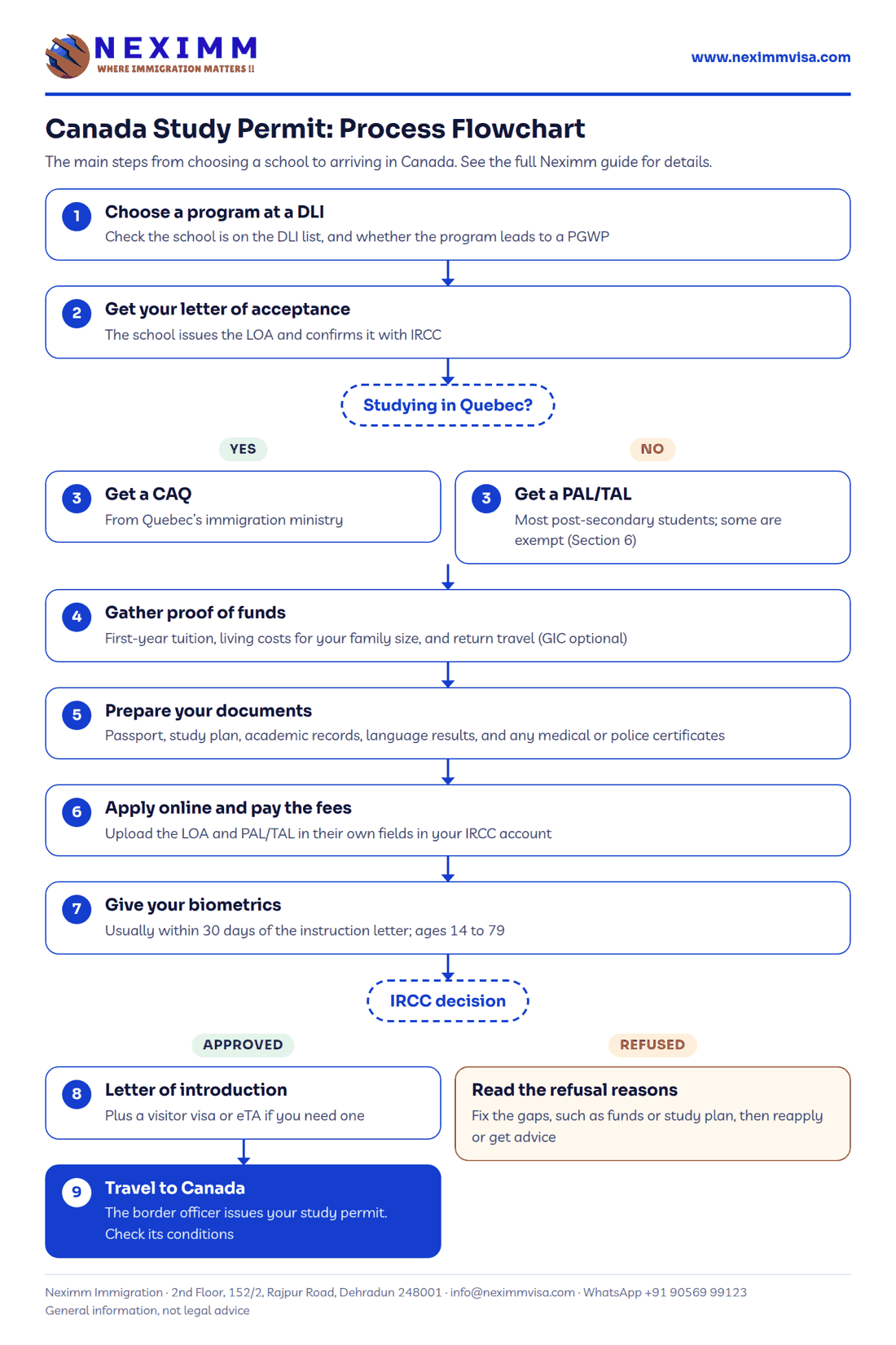
General guide only. IRCC decides each application. Neximm Immigration | www.neximmvisa.com
- Choose your program and check the school is a DLI. Look at the DLI list. For post-secondary programs, also check whether the program leads to a PGWP if you want to work in Canada after graduating.
- Apply to the school and receive your letter of acceptance. The school issues the LOA, then confirms it with IRCC. If the school does not respond, IRCC returns your application and refunds the fee.
- Get your PAL/TAL or CAQ. Most post-secondary students outside Quebec need a PAL/TAL from the school, normally after you accept the offer and pay a tuition deposit. Quebec students need a CAQ instead.
- Gather proof of funds. Show first-year tuition plus living costs at IRCC’s current amount for your family size, and the cost of return travel. Many students buy a GIC to cover the living-cost portion (see Section 8).
- Prepare your supporting documents. These include your passport, study plan (letter of explanation), academic records and language results. Depending on your case, add a custodianship declaration, medical exam and police certificate.
- Apply online through your IRCC account. Upload the LOA and PAL/TAL in their own fields, complete the questionnaire to generate your personalized checklist, and pay the fees.
- Give your biometrics. Applicants aged 14 to 79 usually provide fingerprints and a photo within 30 days of receiving the biometrics instruction letter. Processing begins only after IRCC receives them.
- Respond to any requests and wait for the decision. If you are approved from outside Canada, you receive a port of entry letter of introduction, plus a visa or eTA if you need one.
- Travel to Canada and collect your permit. The border officer issues the study permit when you arrive. Read the conditions printed on it before you leave the counter.
Note: Never travel on the strength of a letter of introduction alone without checking it carefully. Names, dates and school details must match your documents exactly.
6. PAL/TAL and the 2026 Cap
A provincial or territorial attestation letter (PAL/TAL) confirms that the province or territory has set aside one of its study spaces for you. Each applicant needs their own letter, including family members who apply together, and it must go in with the application, not afterward.
Who does not need a PAL/TAL
- Preschool, primary and secondary students (up to grade 12).
- Master’s and doctoral students in degree-granting programs at public DLIs, from January 1, 2026.
- FMCSP students, federally designated military college students and Quebec vocational students (DVS, AVS, STC).
- Exchange students who pay no tuition at a Canadian DLI and Global Affairs Canada scholarship holders.
- Students already in Canada who are extending at the same DLI and the same level of study.
- Certain people in Canada, such as protected persons, holders of a temporary resident permit valid for six months or more, and some permanent residence applicants (humanitarian and compassionate, public policy, or spouse in Canada class).
If you claim an exemption, upload proof of it in the “Client information” field.
2026 study permit targets
| Cohort | Expected permits |
|---|---|
| Master’s and doctoral students at public DLIs (PAL/TAL-exempt) | 49,000 |
| K-12 students (PAL/TAL-exempt) | 115,000 |
| Other PAL/TAL-exempt applicants | 64,000 |
| PAL/TAL-required applicants | 180,000 |
| Total | 408,000 |
The total covers about 155,000 permits for new arrivals and 253,000 extensions. To allow for refusals, IRCC will accept up to 309,670 applications from people who need a PAL/TAL. Alberta has 32,271 application spaces, and British Columbia has 32,596. Once a province uses up its spaces, its schools can no longer issue PAL/TALs, so apply early.
Note: Allocations and exemptions are set by IRCC and the provinces, and they can change during the year. Check IRCC’s page on the 2026 provincial and territorial allocations before you pay a deposit.
7. Proof of Funds
You must show you can pay for your first year of tuition and your living expenses, plus return transportation. The amounts below are for studies outside Quebec and do not include tuition.
| Family members (including you) | Living costs for applications from Sept 1, 2026 |
|---|---|
| 1 | $23,448 |
| 2 | $29,192 |
| 3 | $35,888 |
| 4 | $43,572 |
| 5 | $49,419 |
| 6 | $55,736 |
| 7 | $62,054 |
| Each additional person | $6,318 |
Applications made between January 1, 2025 and August 31, 2026 used the earlier figure of $22,895 for one person. Some country checklists still quote older numbers, so always follow IRCC’s current table.
Evidence IRCC accepts
- Proof of paid first-year tuition and housing.
- A GIC from a Canadian financial institution (see Section 8).
- Bank statements for the past six months, with the source of the money explained.
- An education loan, a scholarship, or funding from a Government of Canada program.
- A sponsor’s letter stating their relationship to you, occupation, dependents and the amount of support, together with their ID.
- Pay stubs, pension documents or rental income records.
Note: The source of your funds matters as much as the amount. Large, recent deposits with no explanation are a frequent cause of refusal. Show where the money came from, whether that is salary, savings, a property sale or a sponsor’s income.
8. GIC: Guaranteed Investment Certificate
A GIC is a Canadian investment with a guaranteed return over a fixed term. For international students, it works as a special account at a Canadian bank that holds your first-year living money and pays it out to you after you land in Canada. IRCC accepts a GIC from a Canadian financial institution as proof of funds.
Is a GIC mandatory? No, not since the Student Direct Stream ended on November 8, 2024. Under the regular stream, it is optional, but it remains one of the clearest ways to prove your living-cost funds. We recommend it for most applicants, particularly those with complicated bank histories.
How a student GIC works
- Open the GIC before you apply. Pick a participating bank, open the student GIC account from your home country and transfer the funds.
- Collect your proof document. The bank issues a letter of attestation, GIC certificate, Investment Directions Confirmation or Investment Balance Confirmation. Upload it with your proof of funds.
- Verify your identity in Canada. After you arrive, confirm your identity with the bank, in person or as the bank directs.
- Receive your money in instalments. The bank releases an initial lump sum, then the balance in monthly or bi-monthly payments over 10 to 12 months.
How much should go into the GIC?
Base your GIC on IRCC’s living-cost amount for one person: $23,448 for applications from September 1, 2026, outside Quebec. Show tuition separately, ideally as a receipt for first-year tuition paid to the school. Funds for accompanying family members do not need to be in the GIC, and you can show them through bank statements or other evidence. Quebec students follow Quebec’s own amount.
Since the SDS closed, some banks let you choose the amount. Scotiabank’s Student GIC Program, for example, accepts $5,000 to $50,000 (plus a $200 fee), and you can show the remaining funds in other ways.
| Item | Recommended evidence |
|---|---|
| Living costs (student) | GIC of $23,448, or equivalent funds with six months of history |
| First-year tuition | Tuition receipt from the DLI, or funds shown separately |
| Family members | Additional funds per IRCC’s table, in any acceptable form |
| Travel | Return transportation for you and your family, in any acceptable form |
Banks that have offered student GICs
IRCC’s former SDS list included Bank of China (Canada), Bank of Montreal (BMO), Scotiabank (with partners Bank of Xi’an and China Everbright Bank), CIBC (including Simplii Financial), Desjardins, Habib Canadian Bank, ICICI Bank Canada, Industrial and Commercial Bank of China (Canada), National Bank of Canada, RBC Royal Bank, SBI Canada Bank, Shinhan Bank Canada and TD Bank. Check each bank’s current fees, processing time and release schedule before paying.
Legal advisory: A GIC does not stand in for the rest of your file. Officers still consider how you will fund later years of a longer program and where the GIC money came from. Keep records of the source, such as a parent’s salary, savings or the sale of property.
9. Documents to Prepare
| Document | Notes |
|---|---|
| Valid passport | A study permit cannot be issued beyond your passport’s expiry date. |
| Letter of acceptance | Upload it only in the LOA field. Not needed for family members whose own permit was approved in writing before they travel to Canada. |
| PAL/TAL or CAQ | Or proof that you are exempt. |
| Proof of funds | See Section 7. |
| Letter of Explanation (study plan) | Explain why this program, why Canada, how it fits your background and career, and what you plan to do after your studies. |
| Academic records and language results | Transcripts, diplomas and IELTS, CELPIP, PTE |
| Custodianship declaration (IMM 5646) | For minors under 17 travelling without a parent or guardian. |
| Medical exam | If you will stay longer than six months and have recently lived in certain countries, or will work in health, child care or education settings. |
| Police certificate | Only if the visa office asks for it. |
| Family documents | Marriage certificate, proof of common-law relationship, children’s birth certificates and each family member’s own forms. |
Note: Always read the visa office instructions for the country you apply from, because some offices ask for extra local documents. The next section covers the main ones.
10. Country-Wise Requirements
IRCC publishes a visa office instruction checklist for each country. These local requirements sit on top of the general checklist (IMM 5483). The table below summarizes the main local points, but IRCC updates these checklists frequently, so download the latest version for your country on IRCC’s study permit application page before you apply.
Legal advisory: Local checklists sometimes quote old funding figures (the Pakistan and Ghana checklists are examples). The current IRCC table in Section 7 always takes priority over any older amount printed on a country checklist.
Select your country to see its local requirements.
India
| Visa office and checklist | New Delhi; IMM 5818 (rev. 12-2024) |
|---|---|
| Proof of funds | Funds at IRCC’s current amounts. Education loans must come from a bank regulated by the Reserve Bank of India (international banks operating in India also qualify). Income tax returns for you and your parents for the past 2 years. A reference letter from each person paying for your studies (occupation, relationship, dependants, contact details) and a letter from their employer. |
| Education documents | Most recent diploma or leaving certificate with mark sheets for the entire program (consolidated mark sheets are not accepted), plus all other certificates, diplomas or degrees with mark sheets. |
| Other local items | Study Permit Questionnaire (in the instructions) and 2 photos taken in the last 6 months. If employed: employer letter dated within 2 months and the last 3 months of pay slips. Minors: notarized authorization from both parents, IMM 5646 if under 17, and parents’ ID. |
China
| Visa office and checklist | Beijing, Guangzhou, Shanghai; IMM 5977 (rev. 02-2026) |
|---|---|
| Proof of funds | Accumulated funds with at least 12 months of history. Original certificates of deposit dated within the last 2 months, deposit slips or passbooks, and house or vehicle certificates. Do not submit life insurance booklets or other contracts. |
| Education documents | Official copy of your most recent diploma or certificate and transcripts. |
| Other local items | Study plan of up to 1 page and the original household registration (hukou). Original employment letters from both parents; notarized business registration if a parent owns a business. IMM 0104 for you and your parents in English or French and Chinese. |
Philippines
| Visa office and checklist | Manila; IMM 5836 |
|---|---|
| Proof of funds | Bank records or fixed deposits for the past 6 months (you, your spouse or parents), with income tax documents and proof of employment or business income. Sponsors provide the same records plus proof of relationship. |
| Education documents | Diplomas, certificates and up-to-date transcripts for all past and current education. |
| Other local items | Original NBI clearance issued within the last 3 months, with dry seal and thumbprint. A study plan that links the program to your background and career goals. |
Nigeria
| Visa office and checklist | See checklist; IMM 5832 (rev. 02-2026) |
|---|---|
| Proof of funds | Certified bank statements or investments for the past 6 months, up to the month you apply or the month before. A MyBankStatement ticket (with ticket ID and passcode) may be included. Business funds need official registration and proof of ownership. |
| Education documents | WAEC, SSCE or NECO results, post-secondary transcripts, certificates and diplomas, and the NYSC certificate if applicable. Street address of every previous school. |
| Other local items | If a non-immediate family member sponsors you, include proof of relationship and an explanation of their support. |
Vietnam
| Visa office and checklist | Ho Chi Minh City; IMM 5572 (rev. 02-2026) |
|---|---|
| Proof of funds | Certificates of deposit dated within the last 2 months, bank books, and your parents’ income and employment evidence. Proof of first-year tuition, if already paid. |
| Education documents | Most recent diploma and school transcripts, plus high school graduation exam results if applicable. |
| Other local items | A study plan covering why Canada, the school and program, your goals, and how the credential improves your employment prospects. Police certificates if over 18, from every country lived in for more than 6 months since age 18. |
Nepal
| Visa office and checklist | See checklist; IMM 5819 (rev. 02-2026) |
|---|---|
| Proof of funds | Supporter’s bank books or statements, a written explanation of the source of funds, a declaration of support and proof of relationship. Unexplained large deposits are not reliable evidence, and funds that cover only study costs may lead to refusal. |
| Education documents | Most recent diploma or certificate and transcript. Current students add a school letter confirming expected completion. |
| Other local items | A student-written study plan of no more than 1 page. |
Bangladesh
| Visa office and checklist | Singapore; IMM 5850 (rev. 02-2026) |
|---|---|
| Proof of funds | At least 4 months of financial history with a written explanation of the source of funds. |
| Education documents | Notarized copies of diplomas and transcripts. |
| Other local items | IELTS Academic results from the last year are highly recommended. A 1-page study plan that includes why you are not studying a similar program at home; add a CV if you have been out of full-time education for over 2 years. Employer letter and income tax records if employed. |
Pakistan
| Visa office and checklist | Islamabad; IMM 5829 (rev. 05-2016) |
|---|---|
| Proof of funds | 12 months of bank statements, with explanations for recent large deposits and for joint or business accounts. A notarized undertaking and parent or sponsor financial documents. The checklist still states CAD$10,000 for living costs, so use IRCC’s current amount in Section 7. |
| Education documents | All previous educational documents and the DLI letter of acceptance (if conditional, show how you will meet the conditions). |
| Other local items | Copy of your National Identity Card (Afghan nationals: Tazkara) and documents showing ties to Pakistan. Police certificate from each country lived in for 6 months or longer since age 18. Employment letters or explanations for any gaps in study. |
Ghana
| Visa office and checklist | See checklist; IMM 5815 (rev. 02-2026) |
|---|---|
| Proof of funds | Bank statements or a bank book for the past 4 months. A sponsor in Canada also provides proof of legal status, employment, a bank statement and the summary page of their latest CRA tax assessment. The checklist states CAN$20,635 (an older figure), so use IRCC’s current amount in Section 7. |
| Education documents | Current letter and transcript from your institution, plus transcripts from the last school year. |
| Other local items | A 1-page study plan covering your goals, alternatives at home, employment benefits and ties. |
Iran
| Visa office and checklist | Ankara; IMM 5816 (rev. 08-2026) |
|---|---|
| Proof of funds | Details of who is funding your studies. Master’s or PhD applicants give details of the funding person or organization. |
| Education documents | Transcripts and graduation certificates from every post-secondary institution attended. |
| Other local items | IELTS or TOEFL, or DELF or TEF, taken within the last 2 years. Master’s or PhD: field of study, planned thesis title and description, and supervisor details in Canada and Iran. Copy of your Shenasname with official translation, and a detailed employment letter if you worked in the last 3 years. |
Mexico
| Visa office and checklist | Mexico City; IMM 5837 (rev. 12-2024) |
|---|---|
| Proof of funds | Bank statements for the past 4 months, plus proof of tuition and residence fees paid. Third-party funders provide a signed letter, photo ID and a bank certificate, all dated within 3 months. |
| Education documents | Not specified in the local checklist; follow IMM 5483. |
| Other local items | Passport valid for at least 6 months with one blank page; non-Mexicans add their Mexican migratory form. Official employment letter for you or your parents. |
Brazil
| Visa office and checklist | São Paulo; IMM 5849 (rev. 02-2026) |
|---|---|
| Proof of funds | Most recent complete tax return and bank statements for the last 3 months. Sponsors provide a signed undertaking and their last 3 months of financial documents. |
| Education documents | Not specified in the local checklist; follow IMM 5483. |
| Other local items | A study plan of about 1 page. Non-Brazilians show proof of status in Brazil; applicants under 17 provide a custodianship declaration. |
Colombia
| Visa office and checklist | Bogotá; IMM 5821 |
|---|---|
| Proof of funds | Bank statements or term deposit certificates for the past 3 months. Investments, voluntary pension funds and tax certificates can help. |
| Education documents | Proof of current enrolment, or a diploma or certificate if studies are complete. |
| Other local items | Employment letter and pay stubs, or business registration and tax documents if self-employed. Former members of the armed forces or police submit their official service record. |
Kenya
| Visa office and checklist | Nairobi; IMM 5839 (rev. 02-2026) |
|---|---|
| Proof of funds | Bank statements for the past 4 months with a signed bank verification consent form; explain lump-sum deposits. Sponsors in Canada add proof of legal status and the summary page of their latest CRA tax assessment. |
| Education documents | Transcripts and certificates, diplomas or degrees from post-secondary institutions. |
| Other local items | A study plan covering why you are not studying at home, employment benefits and ties; add a CV if you have been out of full-time education for over 2 years. |
Sri Lanka
| Visa office and checklist | Colombo; IMM 5934 (rev. 02-2026) |
|---|---|
| Proof of funds | Bank statements or a bank book for the past 4 months, plus documents showing a reliable source of funds. |
| Education documents | A consent form allowing IRCC to verify your documents. |
| Other local items | Evidence of English ability if English is not your first language. A 1-page study plan answering the listed questions. |
United Arab Emirates
| Visa office and checklist | Abu Dhabi; IMM 5814 (rev. 02-2026) |
|---|---|
| Proof of funds | Funds for at least one year, with bank statements covering several months and sponsor documents. |
| Education documents | Education history (dates, school, course and qualification) in the study plan. |
| Other local items | A 1-page study plan answering the listed questions. Copy of the eMedical form if you had a medical exam. |
Morocco
| Visa office and checklist | Rabat; IMM 5846 (rev. 01-2025) |
|---|---|
| Proof of funds | Follow IRCC’s general proof-of-funds rules (Section 7). |
| Education documents | Diplomas and up-to-date transcripts from the last 2 years of the BAC onward. |
| Other local items | Fiche anthropométrique if 18 or older, plus criminal records from every country lived in for over 6 months. Submit both the original-language document and its certified translation. |
Note: Your country is not listed? Choose it on IRCC’s How to apply page to see its visa office instructions. If you live outside your home country, you may also need to prove your legal status in the country where you apply.
11. Where You Can Apply From
From outside Canada
Most students apply online before they travel. Paper applications are accepted only from people with a disability that prevents them from applying online, or from holders of certain refugee or stateless person travel documents.
From inside Canada
Only certain people can apply from within Canada, including:
- Holders of a valid study or work permit, and their spouses, common-law partners and children.
- Minor children in primary or secondary school, and exchange or visiting students.
- People who finished a short course or program that was required for admission to a DLI.
- Holders of a temporary resident permit valid for six months or more, and their families.
- People who are being sponsored for permanent residence and have already applied.
- Families of athletes on Canadian teams, media representatives, clergy, military personnel on duty and accredited foreign representatives.
- Refugee claimants and their family members.
Visitors who are not on this list have to leave Canada and apply from outside. If your study permit has already expired, you can apply to restore your status and for a new permit at the same time.
At a port of entry
Only U.S. citizens, U.S. permanent residents, and residents of Greenland or Saint-Pierre and Miquelon may apply at the border. They must still meet every requirement, including a valid medical exam where one is needed.
12. Minor Children and Custodianship
A child who travels with one parent or a legal guardian does not need a custodian, though they should carry a signed consent letter from the parent who is not travelling. A child aged 17 or younger who comes to study without a parent or guardian must have a custodian in Canada.
- The custodian must live in Canada, be a Canadian citizen or permanent resident, and be at least 19 years old.
- The parents and the custodian must sign a notarized Custodianship Declaration (IMM 5646). Pages 1 and 2 go with the application.
- Students from age 17 up to the provincial age of majority (18 or 19) may also be asked for a custodian.
- If a custody order exists, include proof of custody and the other parent’s consent.
K-12 students already in Canada with a parent who is authorized to work or study usually do not need a study permit. Many families apply anyway, so the child can move smoothly into post-secondary study later.
Legal advisory: Custodianship paperwork must be notarized and consistent across every document. Errors here can delay a minor’s application. Have an RCIC review the forms before you submit.
13. Studying in Quebec
Quebec runs its own selection process. Before applying to IRCC, you need a Quebec Acceptance Certificate (CAQ) for studies, and you submit the CAQ issuance attestation in place of a PAL/TAL. Details are on the Government of Quebec’s immigration site.
- Apply through Quebec’s Arrima portal and pay the $135 fee (2026) within one hour of submitting.
- Upload the required documents within 15 days. Most decisions arrive within 25 business days of a complete file.
- Financial requirements follow Quebec’s criteria, not IRCC’s table in Section 7.
- From December 17, 2025 to December 16, 2027, Quebec caps the number of CAQ applications each institution can submit for vocational, college and university studies. Some exemptions apply, such as continuing the same program or being a dependent child of a worker or student.
14. Fees, Biometrics and Processing
| Fee | Amount (CAN$) |
|---|---|
| Study Permit, including extensions (per person) | $150 |
| Biometrics (one person) | $85 |
| Biometrics (family applying together, maximum) | $170 |
| Quebec CAQ for studies (2026) | $135 |
Your biometrics stay valid for 10 years. Medical exams, police certificates, language tests and visa application center services are paid separately to those providers. Processing times shift weekly, so use IRCC’s processing times tool before you apply.
15. Working While You Study
You can work off campus without a separate work permit if all of the following apply:
- You are a full-time student at a DLI in a post-secondary program (or a Quebec secondary vocational program) of at least six months that leads to a degree, diploma or certificate.
- Your permit allows off-campus work.
- You have already started your program.
- You have a social insurance number.
| Situation | Work allowed |
|---|---|
| During regular academic sessions | Up to 24 hours a week, counting all jobs and self-employment |
| Scheduled breaks (summer, winter, reading week) | Unlimited hours |
| ESL/FSL-only students, and general-interest or prerequisite-only courses. | No off-campus work |
You cannot start working until your studies begin. Working beyond the limit breaks your permit conditions and can damage future applications. IRCC explains the rules on its off-campus work page.
16. Spouses and Children
Since January 21, 2025, a student’s spouse or common-law partner can qualify for an open work permit only if the student is enrolled in one of the following:
- A master’s degree program of 16 months or longer.
- A doctoral degree program.
- A university professional degree: DDS/DMD, LLB/JD/BCL, MD, OD, PharmD/BPharm, DVM, BScN/BSN/BNSc/BN, BEd, or BEng/BASc.
- An eligible program such as the FMCSP or listed provincial bridging programs (for example, UBC’s CP3 or Langara’s Nursing Practice in Canada).
The spouse’s permit is usually valid for the same period as the student’s. Spouses of college diploma students and most bachelor’s students can still visit, or apply for their own work or study permit. Accompanying K-12 children can usually attend school without a study permit when a parent is authorized to study in Canada.
17. Conditions, School Changes and Extensions
As a study permit holder, you must:
- Stay enrolled at your DLI.
- Keep actively studying, full-time or part-time each term (scheduled breaks excluded), and make progress in your program.
- Take no authorized leave longer than 150 days.
Post-secondary DLIs report enrolment to IRCC.
Changing post-secondary schools needs a new study permit through an extension application, with a new PAL/TAL unless you are exempt. Apply before you finish at your current school. You can usually start at the new school only after approval, unless your old DLI closed, cancelled your program or lost its designation.
Changing level of study from secondary to post-secondary usually needs a new PAL/TAL. Moving from post-secondary to a graduate degree at a public DLI does not.
Extensions must be filed more than 30 days before your permit expires.
Changing schools while outside Canada after approval means a fresh application and new fees.
Legal advisory: If IRCC finds that you did not meet your conditions, you may be asked to leave Canada and may have to wait six months before applying for a new permit.
18. After Graduation: PGWP
A post-graduation work permit (PGWP) lets graduates build Canadian work experience, which can support a permanent residence application through Express Entry or a provincial nominee program. IRCC sets out the rules on its PGWP page.
| Program completed | Language requirement | Field of study |
|---|---|---|
| Bachelor’s, master’s or doctoral degree | CLB/NCLC 7 | No requirement |
| Other university program | CLB/NCLC 7 | Eligible field required if the study permit was applied for on or after Nov 1, 2024 |
| College, polytechnic or other non-university program | CLB/NCLC 5 | Eligible field required if the study permit was applied for on or after Nov 1, 2024 |
| PGWP-eligible flight school | None | No requirement |
The program must run at least eight months (900 hours in Quebec) at a PGWP-eligible DLI. Most private college programs delivered under a curriculum licensing agreement with a public college are not eligible. Apply within 180 days of receiving confirmation that you completed your program. Because eligibility starts with the program you choose, think about the PGWP before you apply for the study permit.
19. Why Applications Get Refused
| Reason | What it looks like |
|---|---|
| Weak study plan | The program does not fit your education or career, or looks like a step backward. |
| Funds not proven | Amounts fall below IRCC’s table, or the money has no clear source. |
| Weak ties to home country | The officer is not satisfied that you will leave Canada when your stay ends. |
| Missing or invalid PAL/TAL or CAQ | Also includes an LOA that the school did not confirm. |
| Immigration history | Past overstays, unaddressed refusals or misrepresentation. |
| Incomplete application | Missing biometrics, medical exam or family documents. |
Legal advisory: Misrepresentation, even by accident, can lead to a five-year ban from applying to Canada. If your file has a prior refusal or a gap you cannot explain, speak to an RCIC before reapplying.
20. Building a Strong Study Permit Case
- Pick the right program. Check DLI status, PGWP eligibility, field-of-study lists and PAL/TAL availability before you pay any deposit.
- Write a clear study plan. Connect your past studies, work and future job to the program, and explain any gaps.
- Document your money. Use a GIC, paid tuition and six months of statements, and explain the source of your funds.
- Protect your status. Respect the work-hour limits, stay enrolled and apply to extend more than 30 days before your permit expires.
21. How Neximm Can Help
An IRCC officer assesses a study permit application as a whole. Your letter of acceptance, proof of funds, academic record and study plan are read side by side, and the officer looks for any point where they disagree. Consistency across these documents carries as much weight as the strength of each one.
Typical examples include a tuition receipt that differs from the offer, deposits with no documented source, or a study plan that does not align with the applicant’s previous studies. Even minor inconsistencies can weaken an otherwise strong application.
Neximm Immigration is an RCIC-led consultancy based in Dehradun, India. Canadian immigration advice and representation are provided by a Regulated Canadian Immigration Consultant (RCIC). We support applicants from the initial school shortlist through to arrival at the port of entry, ensuring that every document in the file is complete, accurate and consistent.
This guide is general information based on Immigration, Refugees and Citizenship Canada (IRCC) guidance. It is not legal advice. Rules, fees and funding amounts change often, so confirm the current position on IRCC’s website or with a Regulated Canadian Immigration Consultant (RCIC) before you act.
Neximm Immigration · 2nd Floor, 152/2, Rajpur Road, opp. Scholar’s Home, Jakhan, Dehradun, Uttarakhand 248001 · info@neximmvisa.com · +91 90569 99123 · www.neximmvisa.com